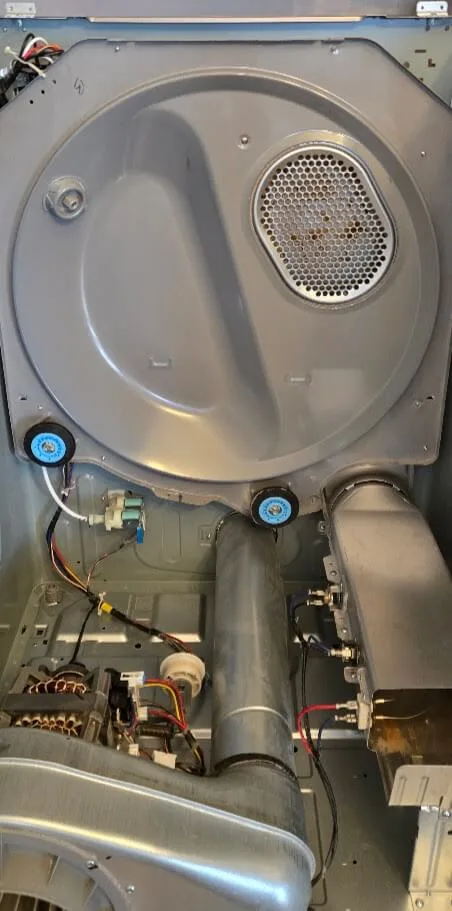
When you are dealing with a samsung electric dryer not heating, few home repair frustrations compare to pulling a damp load of laundry out of your Samsung dryer, only to realize the drum has been spinning in cold air for an hour.
Because the motor and drum lights run on standard 120-volt power, a Samsung dryer can easily tumble, run its timers, and look completely functional while generating zero heat.
Below is an expert technical breakdown of how the 240-volt heating circuit in a Samsung electric dryer operates, the real-world lifespans of heating elements, and step-by-step guidance on identifying why your dryer stopped producing heat.
⚠️ CRITICAL ELECTRICAL SAFETY WARNING
Electric dryers operate on high-voltage 240-volt alternating current (VAC). This voltage level carries enough current to cause severe electrical shock, severe burns, or electrocution.
- Always unplug the dryer or switch off both double-pole circuit breakers before removing rear access panels, touching wiring terminals, or testing internal components.
- Never perform live voltage testing unless you are trained in proper meter safety and wearing appropriate Personal Protective Equipment (PPE).
- If you are uncomfortable working around open electrical connections, consult a licensed appliance technician.
Common Causes of a Samsung Electric Dryer Not Heating
Technician Insight: The “Dropped Leg” 120V Mystery
In my years servicing Samsung laundry equipment across Port St. Lucie, one of the most frequent “dryer not heating” calls I handle turns out to be an electrical supply problem rather than a broken dryer part.
An electric dryer requires two separate 120V hot lines (L1 and L2) coming from your home’s breaker box to create the 240V potential difference needed to power the heating element.
Circuit / LegVoltage ProvidedDryer BehaviorLine 1 (L1) Only120V ACControls light up, drum tumbles, timer runs, NO HEATLine 2 (L2) Only120V ACDryer appears dead / no panel lights or motor operationBoth L1 & L2 Active240V AC PotentialFull Normal Operation & Normal Heating
If one leg of your double-pole breaker trips, a wire burns inside the wall outlet, or a terminal connection loosens, L2 drops out while L1 remains active.
When this happens, the main control board, console lights, and drum motor continue running on the remaining 120V line (L1)—giving the appearance that the dryer is working fine—while the heating element receives zero usable power to create heat. Always verify 240V across L1 and L2 at the wall outlet or terminal block before replacing parts!
The Heating Element: Fixed Wattage & Expected Lifespan
Just like a standard electric stove top burner, a Samsung dryer heating element operates on a fixed wattage (typically around 5,300 watts). It does not turn “low” or “medium” on its own—it burns at 100% capacity whenever 240-volt power is actively applied. To maintain a medium, low, or delicate cycle temperature, the dryer’s control system simply cycles the element on and off at calculated time intervals, similar to how an infinite switch regulates a cooktop burner.
Because the high-nickel heating wire repeatedly expands and contracts under extreme thermal stress every time it cycles, the heating coil is considered a wear-and-tear consumable component.
Expected Element Lifespan by Usage Frequency
Usage LevelAverage Household ProfileEstimated Element LifespanNormal Use3–5 loads per week (1–2 people)7 to 10+ YearsMedium Use6–10 loads per week (Standard family)4 to 6 YearsHeavy Use12+ loads per week (Large family / pets)2 to 3 Years
Note: Restricted vent lines, crushed ductwork, or clogged lint screens trap heat, forcing the element to run significantly hotter and shortening its lifespan by up to 50%.
OEM vs. Aftermarket Heating Elements: Why Cheap Knockoffs Fail Early
When replacing a burnt-out heating coil, it is tempting to pick up an inexpensive aftermarket heating element online for half the price of an original equipment manufacturer (OEM) part. However, budget replacement elements consistently fail long before their expected lifespan.
The Downside of Cheap Aftermarket Elements
- Inferior Metal Alloys: High-quality OEM elements use heavy-gauge Nichrome wire engineered to handle continuous 240V thermal cycles. Generic knockoffs often use thinner, lower-grade wire alloys that degrade and snap under high heat in as little as 3 to 12 months.
- Poor Housing Construction: Off-brand assemblies frequently use thinner metal casings and lower-rated ceramic insulators. This leads to sagging coils, short circuits, or the wire sagging into the housing—causing a grounded element condition.
- Hot-Spot Burnouts: Inconsistent wire gauge thickness creates uneven electrical resistance across the coil. Hot spots form along the wire, causing the coil to melt through rapidly under normal household laundry loads.
🛠️ Technician Tip: Saving $20 on a cheap heating element usually results in doing the entire teardown job twice. Installing an OEM or high-grade replacement ensures proper heat output, protects your main PCB relays, and keeps your Samsung dryer running reliably for years instead of months.
Grounded Heating Elements: Unregulated or Continuous Heat
When a nickel-chromium heating coil breaks from age or overheating, it can drop and physically contact the grounded metal heater housing.
[ Intact Coil ] ───> Controlled by Relays & Thermostats ───> Normal Cycling Heat
[ Grounded Coil ] ───> Touches Metal Heater Casing     ───> RUNAWAY UNREGULATED HEAT!
This creates a grounded element condition. Because the coil is touching grounded metal, electric current bypasses the cycling thermostats and relays, completing the circuit directly through the frame.
- Symptom: The dryer continues heating continuously whenever the drum is turning—even if you select “Air Fluff” or turn the temperature knob to low.
- Risk: Extreme cabinet temperatures, blown thermal fuses, scorched clothing, or tripped home circuit breakers.
Temperature Regulation: Main PCB Control vs. Heater Housing Limit Switches
Samsung dryers rely on a combination of electronic sensors and mechanical safety switches to manage heat levels safely:
1. Main PCB & NTC Thermistor (Temperature Regulation)
The actual temperature control inside the drum is handled electronically. An NTC Thermistor mounted on the exhaust blower housing continuously reads air temperatures exiting the clothes drum and sends resistance signals back to the main PCB. The computer board then toggles the L1 heater relay on and off to maintain your selected dry cycle temperature (Low, Medium, High).
2. Heater Box Thermal Cutoffs & High-Limit Thermostats
Mounted directly on the metal heater housing—typically right in front of or alongside each other—are two electromechanical safety switches:
High-Limit Thermostat / Thermal Fuse: Placed right next to the limit switch on the housing, this is the ultimate safety fail-safe. If airflow completely collapses (e.g., a crushed vent or seized blower wheel), temperatures spike rapidly (180°F+), tripping this safety switch open to permanently or temporarily cut power and prevent a fire hazard.
Housing Operating / Safety Limit Thermostat: Positioned directly on the element box, this switch acts as a localized thermal barrier. If temperatures inside the metal housing spike too high during a cycle, it opens to cut power to the element before thermal damage occurs, resetting once the housing cools down.
Safety Mechanisms & Power Flow Logic
To prevent the red-hot heating element from igniting clothes or melting internal plastics, power must pass through multiple safety gates before reaching the element coils.
1. L1 Power Flow (Control & Relay Circuit)
- Line 1 (L1) enters the dryer from the main power cord and feeds the Main PCB (Printed Circuit Board).
- When you press Start, the PCB microcontroller evaluates the temperature sensors and energizes a heavy-duty heater relay on the board.
- Power flows through the closed relay, passes through the thermal fuse and thermostats, and reaches one side of the heating element.
2. L2 Power Flow & The Motor Centrifugal Switch
- Line 2 (L2) travels down to the drive motor.
- Inside the motor is a mechanical centrifugal switch. When the motor is stationary, this switch remains OPEN.
- Once the motor reaches full operating speed (~1,700 RPM), centrifugal force pushes the switch CLOSED, completing the L2 path to the heating element.
Why This Matters: If the belt breaks, the belt switch shuts down the motor. If the motor seizes or jams, the motor slows down and the centrifugal switch snaps open. In both scenarios, the circuit is broken instantly so the heating element can never run while airflow is stationary.
NTC Thermistors & Sticky Board Relays
Modern Samsung dryers rely on an NTC (Negative Temperature Coefficient) Thermistor located on the blower housing to communicate with the main computer board.
- How It Works: As exhaust temperatures rise, the thermistor’s electrical resistance drops. The main PCB reads these resistance shifts in real time and toggles the heating element relay on or off.
- Stuck / Welded Relays: Over thousands of heating cycles, the high amperage passing through the main PCB heater relay can cause the metal contacts to arc and physically weld shut.
- The Result: Even if the thermistor correctly signals that the drum is overheated, the stuck relay cannot physically open. The dryer will heat erratically, overheat constantly, or trip thermal cutoffs.
External Wiring & Point-of-Failure Checklist
Before buying internal replacement parts, inspect these high-wear electrical delivery points where high current causes resistance heat and burned connections:
[ Wall Receptacle ] ──> [ Power Cord Plug ] ──> [ Dryer Terminal Block ] ──> [ Internal Harness ]- Wall Outlet (Receptacle): Loose internal spring contacts inside 240V wall outlets create high resistance, melting the wall plug prongs or dropping L2 voltage under load.
- Terminal Block Connections: The rear terminal block where the power cord screws onto the dryer chassis is a primary failure point. Loose ring terminals create intense electrical arcing that burns away wire insulation and severs L1 or L2 connections.
- Power Cord / Plug Wire Breakdown: Wiggling or pulling the heavy dryer cord can break internal copper strands inside the molded plug head, cutting off power to half the circuit.
Diagnostic Error Codes Related to Heating Failures
Error CodePrimary MeaningCommon CausestE / tE5 / tSThermistor Sensor ErrorDefective NTC Thermistor or Board HarnesshE / HC / HC4Heating Error (Over/Under Temp)Blown Element, Tripped High-Limit, Clogged DuctbE / bE2Stuck Button / Control Board FaultMain PCB Relay Shorted or Faulty Membrane
Professional Samsung Dryer Repair in Port St. Lucie
If your Samsung electric dryer is spinning cold, overheating, or shutting down mid-cycle, resolving the issue requires systematic 240V diagnostic tracing to protect your internal components and keep your home safe.
At Port St. Lucie Appliance Repair, we specialize in diagnosing complex 240V heating loops, replacing burned elements, rebuilding terminal blocks, and clearing clogged ventilation paths throughout Port St. Lucie.
Ready to book? Call (772) 501-9870 or contact us.
FAQ · Family-owned Port St. Lucie
Frequently Asked Questions About Dryer Repair
Why is my Samsung electric dryer running but not heating?
The most common cause is a broken heating element, which can burn out over time due to restricted airflow. Other potential culprits include a blown thermal fuse, a failed high-limit thermostat, or a faulty control board. Our local technicians carry OEM replacement parts to diagnose and fix these issues on the first
How much does it cost to fix a Samsung dryer that won't heat in Port St. Lucie?
Repair costs depend on the exact failing component, such as the thermal fuse or the heating element assembly. At Port St. Lucie Appliance Repair, we waive our diagnostic fee with any completed repair, ensuring you only pay for the actual fix with no hidden charges.
Can I get same-day service for my Samsung dryer repair?
Yes. We offer same-day dispatch throughout Port St. Lucie and the surrounding Treasure Coast areas. Our licensed, family-owned business prioritizes urgent laundry room repairs, arriving with fully stocked trucks to get your Samsung dryer heating again immediately.