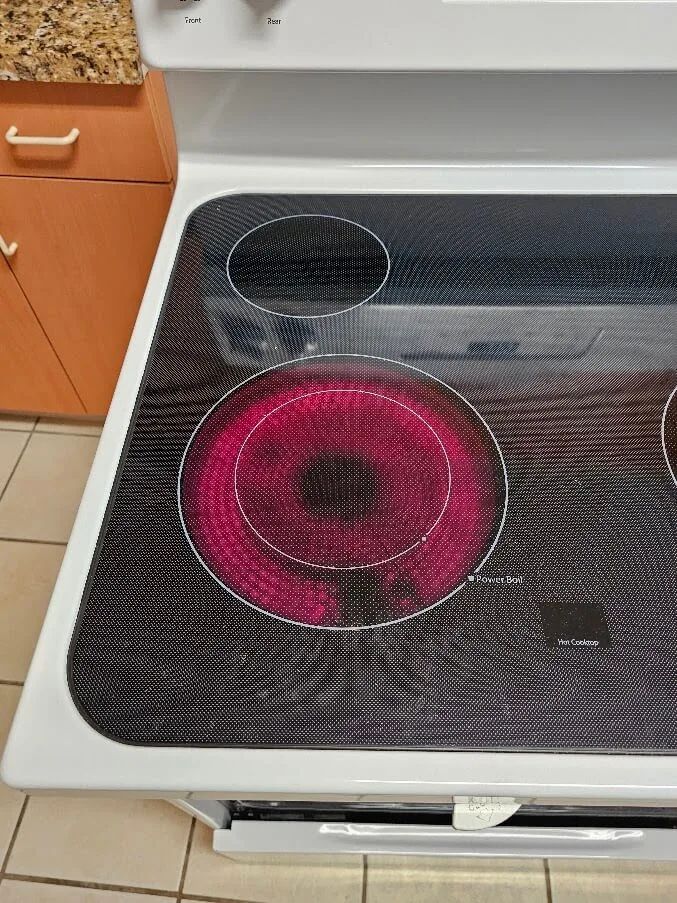
When a glass top stove burner stuck on high suddenly heats at maximum output regardless of the dial setting, the issue is rarely the heating element itself. Instead, it stems from a failure in the power regulation circuit. For help diagnosing other kitchen appliances, check out our full collection of Appliance Troubleshooting Guides. Understanding how infinite switches regulate energy, how dual/triple elements operate, and how line voltage is distributed across ranges helps clarify why runaway heating occurs and how to safely diagnose it.
1. Why a Glass Top Stove Burner Gets Stuck on High: Infinite Switch Failure
Unlike an oven, which uses a temperature sensor (RTD probe) to maintain an exact temperature in degrees, a standard electric cooktop burner operates on duty-cycle power modulation.
[ Line 1 (120V) ] ──> [ Infinite Switch Bimetal ] ──> [ Burner Coil ] ──> [ Line 2 (120V) ]
                                 │
                   (Cycles ON/OFF via Internal Heater)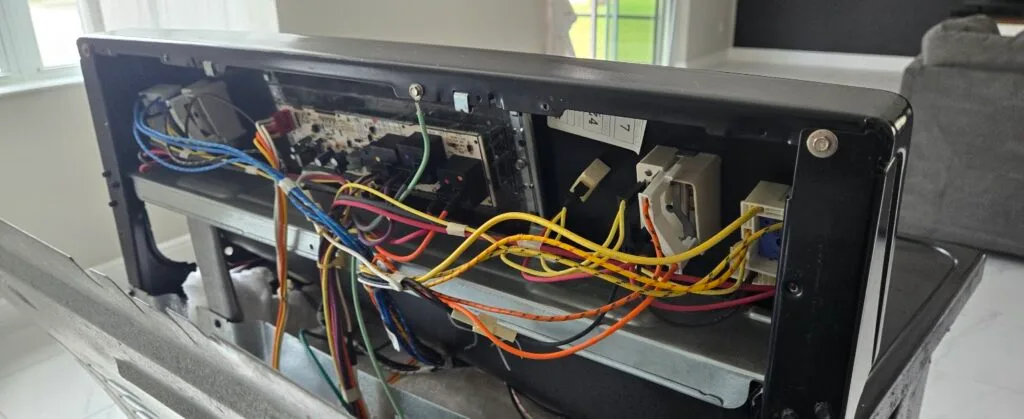
The Role of the Infinite Switch (Simmerstat)
Behind the control knob sits the infinite switch. Because an electric burner coil cannot vary its internal resistance to change heat output, the switch regulates surface temperature using a heat-actuated bimetal mechanism:
- Internal Heater & Bimetal Strip: Inside the switch, a small resistance heater sits directly against a flexible bimetal contact arm.
- Current Flow & Heating: When you turn the control knob, power flows simultaneously to the burner coil and the switch’s internal heater.
- Thermal Break: As the internal heater warms the bimetal strip, the metal expands and bends, mechanically snapping open the contacts and interrupting power.
- Cool-Down Cycle: Once power cuts, the internal heater cools down, allowing the bimetal strip to spring back and re-close the contacts.
How Settings Work: Turning the knob adjusts the mechanical tension or physical gap against the bimetal strip. Lower settings require less heat to pop the contacts open (short ON time), while higher settings hold the contacts closed longer before flexing.
Why “Runaway Heating” Happens
If the mechanical contacts inside the infinite switch weld/fuse together due to electrical arcing, or if the internal bimetal heater fails open, the switch loses its ability to cycle power. The contacts remain stuck closed, sending continuous 240V power to the burner. Even if the knob is turned down to “1” or “Simmer,” the coil stays trapped at 100% maximum temperature—creating a severe thermal runaway and food-burning hazard.
If the mechanical contacts inside the infinite switch weld/fuse together due to electrical arcing, or if the internal bimetal heater fails open, the switch loses its ability to cycle power. If you suspect your switch has failed closed, follow this step-by-step guide to test and replace a Whirlpool range infinite switch using a multimeter.
2. Radiant Surface Elements: Single vs. Multi-Zone Burners
Radiant heating elements sitting underneath smooth glass-top cooktops consist of delicate ribbon-style heating wires resting inside an insulated ceramic tray.
Burner TypeInternal ConstructionWiring & Switch ComplexitySingle ElementA single ribbon coil loop spanning the full diameter of the burner ring.Standard 4-wire or 5-wire infinite switch. Simple ON/OFF duty cycle across the entire surface.Multi-Zone Element (Dual / Triple)Concentric inner and outer ribbon rings separated by insulation barriers.Requires a specialized multi-position infinite switch or relay board. Energizes the inner ring alone for small pans, or both inner and outer rings simultaneously for large cookware.
Replacing Glass-Top Radiant Elements: High Component Costs
Unlike traditional exposed-coil plug-in surface elements, radiant glass-top elements are integrated units that include:
- Precision-wound ribbon wire.
- A high-temperature ceramic insulation tray.
- A built-in spring-loaded Limiter / Hot Surface Indicator Switch spanning across the center.
Because of this integrated assembly, replacement radiant elements carry a significantly higher part cost compared to standard drip-pan coils or control switches. Before replacing an expensive radiant element for a runaway heat complaint, always test the infinite switch first—in over 90% of runaway heating cases, the switch is the failed component, not the heating coil.
3. High Voltage Safety Warning: $240\text{V}$ Line Diagnostics
Electric ranges operate on a split-phase 120V/240V AC supply. The total potential across Line 1 L1 and Line 2 L2 is 240V, carrying enough energy to cause severe electrical shock, arc flashes, or component destruction.
SAFETY NOTICE / TECHNICIAN WARNING: Never remove the rear access panel or service infinite switches while the range is connected to power. Always disconnect the 4-prong/3-prong range plug or trip both poles of the dedicated double-pole circuit breaker at the main service panel before removing access panels. Always use a digital multimeter to verify 0V AC across L1, L2 , and Neutral before touching internal terminals.
4. Range Power Distribution: Parallel Oven & Cooktop Circuits
A common point of confusion is why cooktop burners continue working when the oven bake or broil functions completely fail (or vice versa).
                            ┌───> [ Surface Element Switches ] ───> [ Cooktop Burners ] 240V
[ Main L1/L2 Terminal Block ]│
                            └───> [ Control Board / Relays ]   ───> [ Oven Bake/Broil ] 240V
Parallel Circuit Branching
Inside the range wiring harness, power enters from the wall cord at the main terminal block and splits into independent parallel branch circuits:
- Cooktop Circuit Branch: L1 and L2 power feed directly to the common supply bus on the infinite switches. Each burner operates on its own sub-branch in parallel with the other burners.
- Oven Circuit Branch: L1 and L2 route to the electronic oven control board (DLB / Double Line Break relay) and bake/broil relays.
Because these two branches run in parallel, an open circuit in the oven (such as a blown oven thermal fuse, failed bake element, or damaged control board relay) does not break the circuit path feeding the surface burner switches. The cooktop burners will continue to operate normally even if the oven is completely dead.
5. Professional Stove & Range Repair in Port St. Lucie
While diagnosing runaway heating and infinite switch failures is straightforward, working with 240V high-voltage circuits and delicate glass-top cooktop assemblies requires specialized care. Improper handling can easily shatter expensive ceramic glass or cause electrical shorts in your home’s wiring.
If your stove burner is stuck on high heat, your oven won’t heat, or you need expert diagnostic assistance, the team at Port St. Lucie Appliance Repair is here to help. We provide fast, reliable repair services across Port St. Lucie and surrounding areas to get your kitchen running safely.
Need help fixing your glass-top stove?
See our oven, stove & range repair service for full coverage details.
Ready to book? Call (772) 501-9870 or contact us.
FAQ · Family-owned Port St. Lucie
Frequently Asked Questions About Oven, Stove & Range Repair
Why is my glass-top stove burner stuck on the highest heat setting?
This dangerous issue is almost always caused by a failed infinite switch. The switch regulates the power cycling to the burner; when it shorts out internally, it continuously delivers 240 volts of electricity, keeping the element locked on high regardless of where you turn the dial.
Is it safe to use a stove with a burner stuck on high?
No, it is not safe. A burner locked on high poses a severe fire hazard and can easily shatter your ceramic glass cooktop. We recommend unplugging the stove or flipping the circuit breaker off immediately, then calling our local team for a professional same-day diagnostic and switch replacement.
How much does it cost to fix a stove burner stuck on high in Port St. Lucie?
The cost depends on your stove's make and model, but we waive our diagnostic fee entirely when you choose us to complete the repair. As a local, family-owned business, we carry common infinite switches on our trucks to ensure we can resolve your stove emergency safely on our very first visit.